Tone is everything and when you find it nothing is the same again.
My Dogs Bollocks is all the things that might help you get your tone or put a smile on your face.
Don't know what tone is, then this page is just a load of BOLLOCKS.
You can now follow My Dog's Bollocks on Twatter.... https://twitter.com/KeithJayJohns
Awesome is the only word to describe the AsharpFretworks BiasPro VI....The black art that is amp biasing has now become easier than changing a set of strings....Again....Awesome....
The hard part of the biasing process in finding your tubes maximum power dissipation rating...."the tubes power output in watts to anybody that doesn't know"....and this is hardly top secret....practically all the online shops that sell tubes give this rating in the information about a particular tube if not in the title line of said tube....
I started off with my Evil Robot....a self biasing amp....?....over 3 days checked both the plate voltage and the cathode current with the BiasPro VI and each time got the same ratings....spot on....this told me two things....1. that the Evil Robot is rock steady and 2. that the BiasPro is also rock steady....any wavering in these ratings and something is not worth the money....
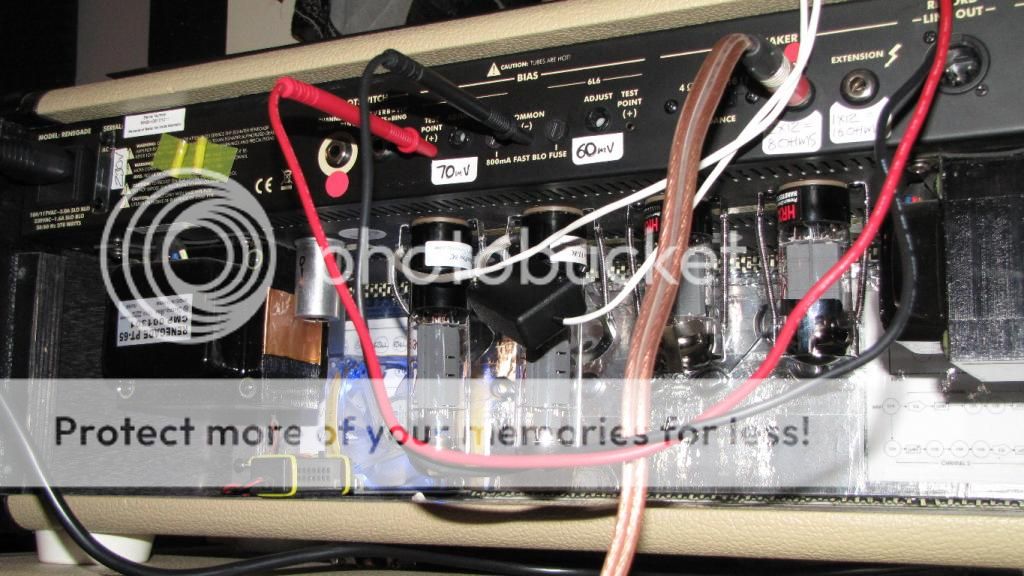
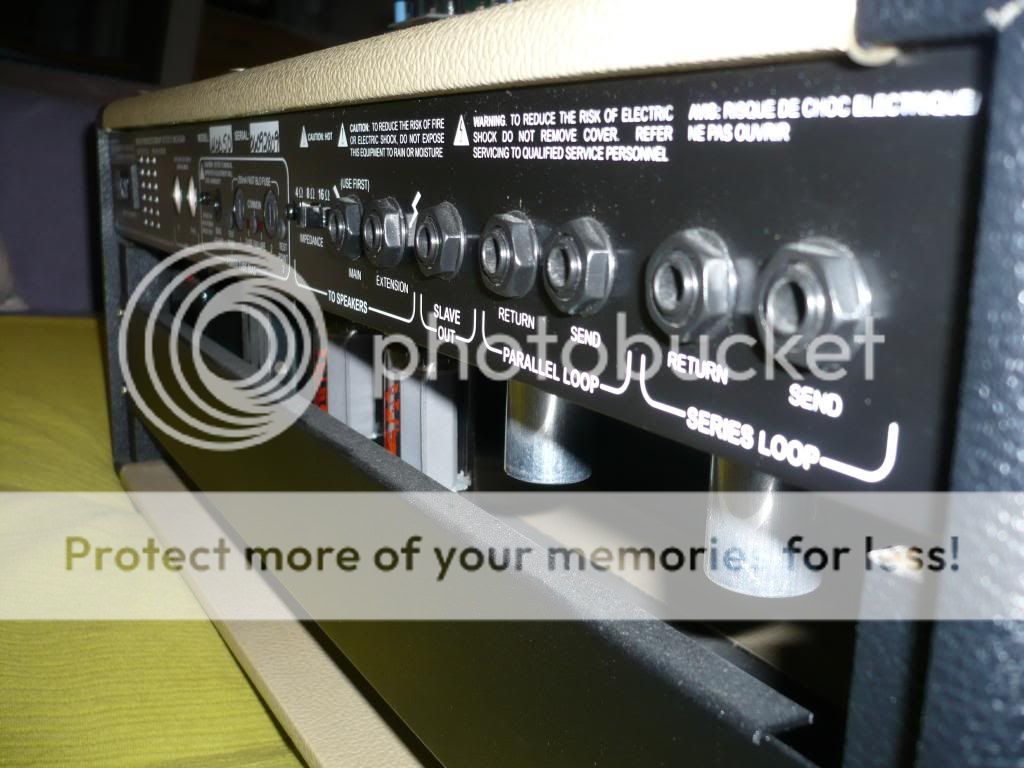
Onto the Egnater Renagade....This amp has biasing probe points on the back panel with a section in the manual on how to bias the amp yourself using any number of tubes...I had always thought that my Renagade sounded sweet....Channel 1 has 6V6's to give me a very retro tone and with a Tele gives a very passable Keef Tone and has Twang aplenty....Channel 2 has EL34's to give a very Egnater modern rock tone....tons of fun....can be a bit much....but dialed in with the 6V6's is just about a perfect do anything amp....the 6V6's taking the edge off the 80s metal tone....
"ignore the multimeter in the photos....its not needed....it's plugged into the Renegades test points"
Using the BiasPro the 6V6's were too hot just enough to lessen their lifespan but not enough to sound too hot using the settings from the Egnater Manual....The EL34's on the other hand were well out....not hot enough....If you have read my other posts on the Renegade you'll know I have spent ages trying to find the perfect tubes for this amp and it would seem all I really needed was to bias the amp better....seems so stupidly simple now but if anybody was going to kill their amp trying to do a DIY Bias it would have been me....
Using the AsharpFretworks BiasPro VI is simplicity itself....all you need to know is your tubes power rating....then with the probes installed under the tubes in your amp the BiasPro gives you the two other values needed to bias your amp perfectly....One of the probes cables has a little box with a toggle switch on it and the switch gives you either the Plate Voltage or the Cathode Current and that's it....Different amps will have different PV's and not knowing your amps PV is going to make any bias setting a wild stab in the dark....you only need to be a little out and your risking bad tone at best and a tube letting go at worst....The CC is your amps bias setting....
Maximum Power Dissipation Rating
JJ 6V6 S = 14watts
JJ E34L = 25watts
JJ 6L6 GC = 30watts
Tung-Sol 5881 = 23watts
TAD 6L6WGC-STR = 30watts
You then divide your amps Plate Voltage by your tubes power rating....this gives you the tubes maximum bias current....then you need to set your amp to 70% of this maximum current....
JJ E34L 25w/440 Plate Voltage = 56.8 maximum bias current
56.8 x 70 and hit the % button on a calculator gives you 39.7
39.7 being the magic number....it really is as easy as that....
"if you can not see this video in the email Blogger version....click HERE"
The BiasPro VI is designed and built in the US by Ken Koga of AsharpFretworks....they look like they are built to last....not at all like something your mate made for you....the cables that make up the probes are as good as anything I've bought over the years not cheep and flimsy looking...it comes with two probes but if you need or want 4 you can buy two more....The probes are the big eight pin versions....you can also get nine pin versions for EL84's....two more probes would have been best for my Marshalls....it will just take me longer to bias my JCM900 but I can live with that....The BiasPro will also show you how well matched your tubes are....but best of all....it works and works very well....is stupidly simple to use and for the money I think every guitarist with a tube amp needs one....My Egnater is an even better amp that I thought it was with a perfect biasing....now on to my other amps....cheers Ken your a star....this thing ROCKS....k.j.
In the never ending search for more tone the things that we change the least are our tubes. Most of us never giving them a second thought, a blown tube is replaced with the same make and model that the amp came with....easy....but the difference between tubes can be as stark as night and day....sort of....
Changing Pre Amp and Power Amp Tubes is never going to make a Fender amp sound like a Marshall or visa versa but they can make your amp sound and play more to your liking....just remember that 90% of how your amp sounds is in its design, not it's tubes.
12AX7 - ECC83
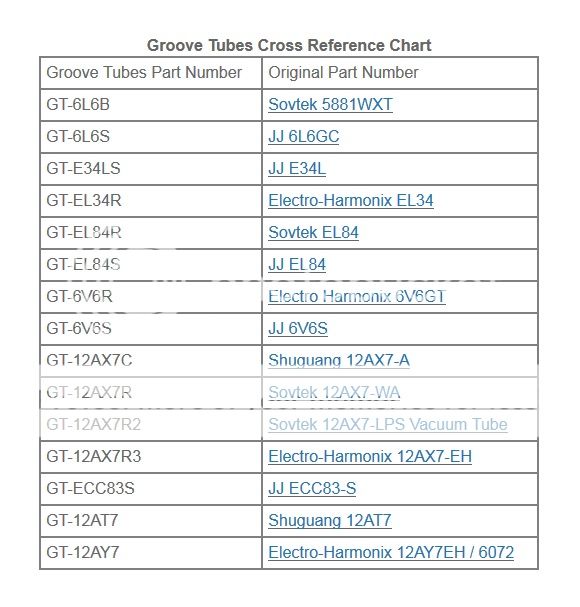
There are lots of big names in the tube world, Sovtek, Electro-Harmonix, JJ Electronic, Tung-Sol, but not all manufacture tubes. GT and Ruby don't make their own tubes, they buy in and re-brand tubes with their own logo. GT have recently been bought by Fender who only use GT tubes in their amps, a good way of keeping your amp sounding it's best is to use nothing but GT tubes....But talk to a lot of Fender amp owners and Tung-Sol tubes seem to be the preferred choice.
The GT Guess Who Hall of Shame
Tung-Sol have masses of musicality, I'd call them tight and airy. Electro Harmonix are very similar to Tung-Sol but break up sooner for better blues and rock tones. JJ's on the other hand are huge in the bass department with hard mids and clean highs, great for Marshalls and Humbuckers. I have a pair of GT 7025 that were the best tubes I had ever played but they don’t sell them any more. They still sell a 7025 but it's not the same long plate version and they don’t sound the same.
Tube Names - Gain Factors
From the above chart you can see the gain values of each tube and that a 12AX7 “US Name” is the same tube as a ECC83 “European Name”. I have always thought the euro names were misleading in that the ECC81 has more gain than a ECC82, so where does the ECC83 get it's name, it should be a ECC80?. I have put the 5751 in the 12AX7 line as its very closely related to a AX7, it's more closely related to a AX7 than it is to a 12AT7 or a 12AU7.
Pre Amp Tubes
JJ ECC803 - Slovakian - a very high powered 12AX7 tube, extra bite and shimmer in the high frequencies.
Tung-Sol 12AX7 - Russian - very powerful, ultra low noise. tight, punchy, articulate, a very musical tube.
Electro Harmonix - 12AX7 - Russian - easy break up, aggressive, very low noise. probably the best tube in the world and one of the cheapest.
JJ 5751 – Slovakian – low powered 12AX7, very low noise. has bite and shimmer with a good low end.
JJ ECC82 - Slovakian - the lowest output tube you can get. In the pre amp it will reduce gain and give a warm, smooth and balanced EQ out put.
Sovtek 12AX7-LPS - Russian - surprisingly smooth across the EQ response - great for gain but prone to micro-phonics in combo amps.
Glass Tubes of Power Perfection
Power Amp Tubes
6V6 Power Tubes have a vintage tone giving an even mix of lows, mids and highs. they have a lower power out put compared to 6L6's
6L6 Power Tubes have a very nice mix of tone. they sound tighter and warmer than 6V6's. a 5881 is basically a low power 6L6....20watt rather than 30watt. A KT66 has a smoother tone with tight lows.
EL34 Power Tubes have a harsher tone with more bass response than 6L6 or 6V6 tubes, more like a classic Marshall sound. a KT77 tight mids with more open highs than a EL34
KT88 Power Tubes similar to a smaller EL84 in the mids, but with more lows and highs for a modern Marshall sound.
Yellow Jackets tube converters allow EL84 power tubes to be used in place of 6L6, EL34, 6V6. EL84's have a lower power out put compared to EL34's but use a small 9 pin design rather than the 8 pin design of 6V6, 6L6, EL34 and KT tubes.
Changing Power Tubes....all 8 pin power tubes can be changed for any other 8 pin tube, "some tubes missing pins" but will involve re-baising of most guitar amps and should only be done by qualified technician.
My Egnater Renegade has a very modern sounding lead channel that I have lowered the gain on with the aid of a 12AU7 for a vintage Marshall, AC-DC tone. My clean channel, I have emphasized the US Fender tone with a JJ ECC803s for some extra grit in the top end.
The tubes that I have in the Renegade at the moment for home use are......
“Channel 1”
V1 - Tung-Sol 12AU7 "has a gain factor of 20%, this reducers the gain in both channels"
V2 - JJ ECC803S “for some dirt in the top end” (this is now a Tung-Sol 12AX7 - sounds better)
“Channel 2”
V3 - JJ ECC83S "12AX7" (this is now a JJ ECC82 - sounds better)
V4 - JJ ECC83S "12AX7"
“FX Loop”
V5 - JJ 5751 "low powered 12AX7, for giving the FX Loop a bit more headroom"
“Phase Inverter”
V6 - Tung-Sol 12AX7
"with these tubes Channel 1 is clean with a hint of break up when pushed, Channel 2 is very Vintage Rock sounding"
POWER TUBES
6V6's in the 6L6 side to reduce the volume a very small amount for a US Tone.
EL34's in the EL34 for the British Tone.
"the Renegade has 2 channel assignable Master Volumes, so I use the 2 MV to give the 6V6 tubes a boost to keep up with the EL34's"
The valves that I have in the Renegade for gig use are......
“Channel 1”
V1 - JJ ECC83S
V2 - JJ ECC803S “for some dirt in the top end”
“Channel 2”
V3 - JJ ECC83S "12AX7"
V4 - JJ ECC82 "12AU7" "to reduce the Egnater's Modern Gain Tone...."
“FX Loop”
V5 - JJ 5751 "low powered 12AX7, for giving the FX Loop a bit more headroom"
“Phase Inverter”
V6 - Tung-Sol 12AX7...."I also use a Tung-Sol 12AU7 to drop the power output through the floor for home use"
POWER TUBES
6L6's in the US Tone Side.
E34L's in the EL34 side for the British Tone.
"These tubes give a very tight powerful tone, Channel 2 has reduced gain to keep it sounding Rock not Metal. The 12AV7 in the PI position will help to get sustain and dynamics at a lower volume for home use."
Power Tube Distortion....the holy grail of tone....actually comes from the Phase Inverter tube breaking up. Fitting an 12AU7 tube will cut a amps rated power to about half....but a 100watt amp is not twice as loud as a 50watt amp, it's more like 100watt and 75watt and it's the same with valves. Fitting a 5751 in a 100watt amp will make it sound like a 90watt amp and fitting a ECC82 will make the 100watt amp sound more like 40watts....what the AU7 does is give you more sustain and playing dynamics at a lower volume. The AU7 will start to break up sooner than a AX7 would....your amp will still be loud....DRUM KIT LOUD.
GT 7025 - Tung-Sol 12AX7 - JJ ECC803S
A word of warning....
12AU7 and 12AT7 tubes have Plate Currents of about 1 milliamps where the 12AT7 and 12AU7 both have Plate currents of 10 milliamps and will draw more current. Modern high quality resistors will cope with extra heat but....not all amps are built to the same standard.
I contacted Bruce Egnater about using a AU7 in the PI position and this is what he said....
"You won't harm your amp by trying the 12AU7. The issue is that the AU7 draws more current. The Renegade uses 1 watt MF resistors in the critical locations. The 12AU7 will cause more voltage drop (more heat) on those resistors but should be just fine. The fact that the Renegade does not have a post phase inverter master and does have negative feedback in the poweramp, the audible change with the AU7 will probably be minimal and will not reduce the volume if that is your goal."
JJ ECC81 - Ruby 12AT7
The best way to evaluate what tubes will sound best for you is to buy a few and play and swop . Check forums to see what other users of your amp are playing through but remember that how you play will also have an effect, if you play heavy handed you will make a valve break up sooner than a softer player would. I have found that some tubes don't play nice with other tubes, bottom end can simply drop away with some combinations of tubes. 12AT7/ECC81 tubes can be cold and un-musical when compared to the lower powered 12AU7/ECC82 in the same positions.
A good tip when you buy balanced tubes for the FX Loop or Phase Inverter....mark them with a red Sharpie marker pen....because once out of the box you'll never know which ones which.
Spot the Difference Competition
I think my amp does sound better for changing it's tubes for my heavy handed style of playing....but it has been a pain in the ass if I'm being honest....
If your Egnater Footswitch has come with a hard wired cable...it will eventually crap out. Why they had to use 2 stereo jacks to plug it into the amp I will never know....when a easily bought everywhere midi cable would have worked so much better. I have posted this mod on the Egnater Forum but thought I'd post it hear as-well....
Mine broke in the cable near the footswitch so I had to mod it with a new detachable cable and a breakout box made from a Jacky D tin for coolness.
Anywho....if you go to my Photobucket page I've put up 25 photos that will clearly show how I've done it. The things you are going to need is 2x Chassis Socket, Din, 5p 180....that's a
female midi socket you can find off eBay. I used ones with a screw down locking ring but that was overkill....clearly. Midi cable of any length you think you'll use, a cheap 1 meter TRS cable to cut in half and use for the breakout box and a cool tin for the said breakout box.
It's another simple mod that shouldn't take too long....once done you'll never need to do it again....
From my other Egnater post this quote made me laugh....
"Now you can go to Guitar Center and get a $35 piece of Korean crap with distortion."
It sums up the Egnater forum very well, it has it all Guitar Center, Korean "I'll add China" and crap....
I'm sure the Egnater forum is exactly the same as most forums, full of people either loving or hating. The Egnater forum is split into two camps, the hand wired made in the US camp and the made in China camp. The made in China camp does seem to have all the problems and these problems can be split between just a bad tube easy fix type and the more terminal type. The hand wired camp beleive that the China amps have cheapened the Egnater brand and are only too happy to say so, "your problem is you've bought a shit amp" and "you can't polish a terd". It's really a difference between hand wired and printed circuit board amps, one being better than the other, but some of the things you can desgin into a circuit board amp you just can't get a hand wired amp to do. so in the end it all comes down to quality of manufacture and of quality control, a good sounding amp is a good amp. So are the made in China Egnater amps good amps.....
I can't compair US v China made amps as I don't have as US made Egnater "you can't get the US Modular in the UK" but I can compair two far east made amps....
Blackstar Series One v Egnater Renegade 65.
I've had both amps for about 18 months and have given them both a fair amount of abuse.....The Blackstar is made in Korea while the Egnater Renegade is made in China.
The looks department.... the BS is a very cool looking amp, all Black on Black and very Rock. The ER looks a tad retro. But when compaired to a US made Egnater, both look the same, same matt black paint, same font, same knobs in cream and the same black and tan tolex type of covering, it's an Egnater, it's how all Egnaters look. A Blackstar win I think.
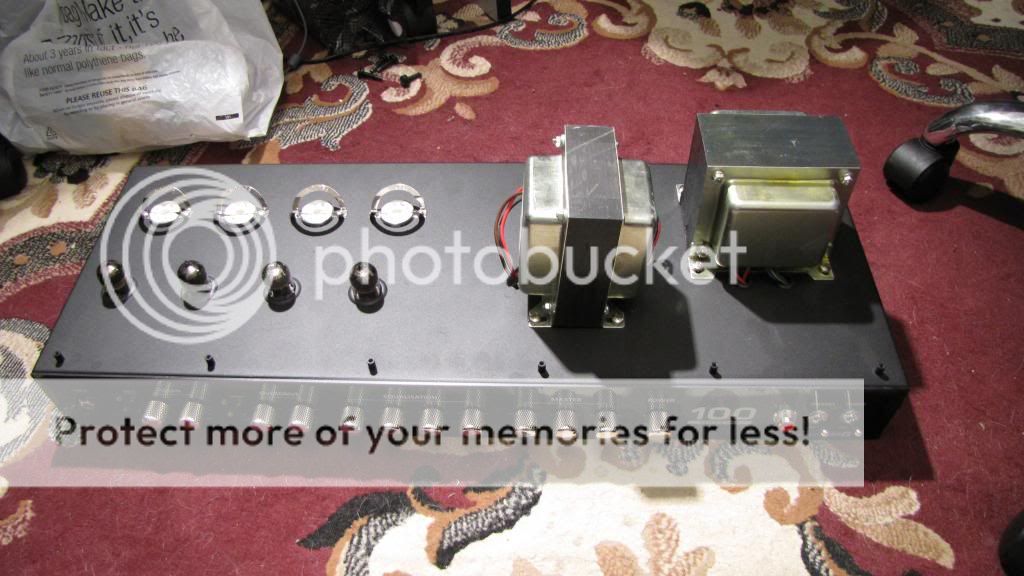
Construction....again the Blackstar has it, beefier wooden case and the chassis is made of heavier gauge steel. Both amps have been drop tested.....the Blackstar had been back to Northampton and repaired 3 times and on one occastion came back like this.
I had wrapped the amp very well in its box with it's foam supports then wrapped the box in thick polyurathain. Blackstar sent it back just in it's box with bubble wrap for padding....the bubble wrap didn't work did it.
The BS came through the drop test very well, only one of it's rather large transformers bending it's retaining braket. A word about the BS transformers, they are massive, heavy and both on the same side of the amp making carring the amp a real pain in the arse....I'll say that again because carring it is a major pain in the arse. Blackstar loose a point.
The Egnater, well erm....in it's defense, it had come all the way from China and it looked as if it's chassis bolts had come loose and after several bumps the wieght of the transformer bent the chassis.
Not good. This first amp I had replaced, it did work perfectly for the two weeks it took to get a replacement. Both amps get a point taken away.
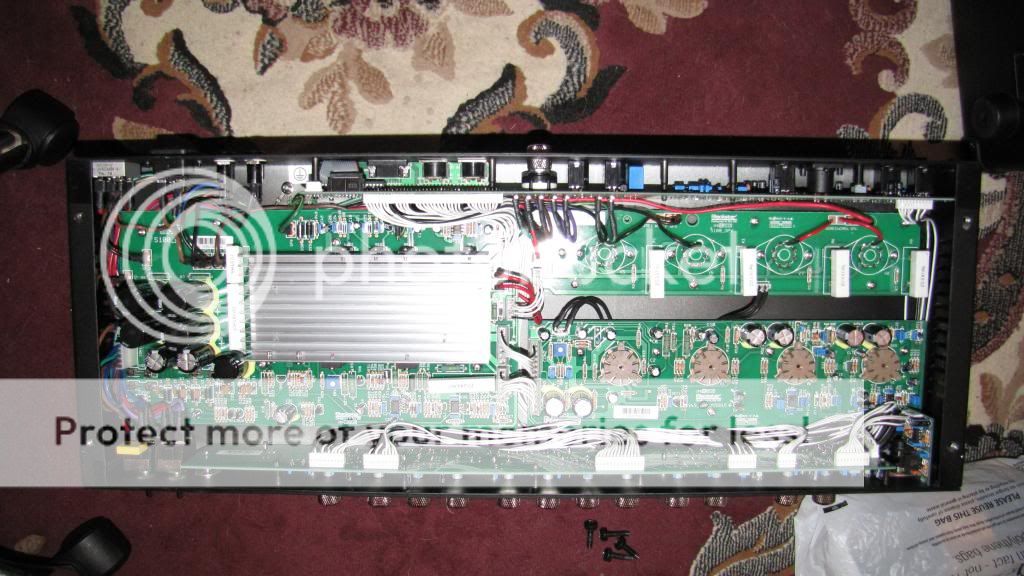
The internals....both amps are very simaller. The BS is very clean, the ER looks a tad messy with it's thick hook up wires....
I prefer the big thick hook up wires in the ER rather than the thin things that would'nt look out of place in a PC in the BS. Egnater Win....
The Rears....again both amps are pretty much the same on the back with recording outputs, two speaker outputs and FX Loops. The BS has a +4-10db pad switch, the E has it's loop pad switch internally but it's loop is tube buffered. The BS has MIDI for control of other MIDI equipment. The ER has a very usfull tube biasing control so you can bias new power tubes yourself. I call it a draw....
The two channels in the ER are exactly the same with gain, bass, middle, treble, tube mix, channel volume and both with toggle switches for 65watt/18watt, tight/deep, bright/normal. Channel 1 is clean and Channel 2 is the dirty. Both channels have independent reverb controls. The power section has density and presence controls and two master volumes that are foot-switch controllable. The ER has the better F/S only let down by a wired on cable that at some point will break, the amp does need the F/S to work at its best. The F/S has switches on the effects, reverb and Main 2 volume that lets you have them set on CH1 or CH2 or Both.
The BS is a simpler affair, channel 1 just has gain, volume and the two mode switches, bright clean and warm clean. Channel 2 is the overdrive channel with crunch and super crunch modes. It gets a full EQ section of bass, middle, treble and the ISF tube mix knob. The master section has resonance, presence, volume and finishes with the power DPR knob. I'll sit on the fence and say both amps get a point.
The Sounds....both amps try to produce British and US tones but go about it in different ways. The BS uses four EL34 and some very clever EQing and Power Tube manipulation? to do it's thang while the ER uses two 6L6 tubes to do the US tones and two EL34 to do the British thing, very simple....just like having two amps in one box.
The BS sounds awesome, it's four modes are well dialed in, the Super Crunch is killer, the amp is almost plug and play. You don't get much control, it just does what it does. It will never give you a duff tone and for me that's the big problem, after awhile it gets a bit boring. When I first got my Marshall JMP-1 midi pre amp I paired it with a Marshall Valvestate power amp....I went through three of them and they all died the same horrible deaths....after no more than twenty minutes of playing they would go up in a puff of smoke and through the grill in the amp housing you could see a black block of plastic with a hole in it. The processor/integrated circuit or what ever it was that was doing all the clever valvestate stuff had got too hot and blown it's own brains out.
Could it be the same sort of thing under that big heat sink in the BS. Is the BS a modelling amp at it's heart.....Don't get me wrong it's a great sounding amp but the ER is an amp you can keep tweeking and it's tone just keeps getting better. It's an amp you need to learn how to get the best from, but when you know where the sounds are it's really easy to dial them back in. I have never had an amp that sounds as good loud as it does quiet. The BS has it's "Dynamic Power Reduction" and it works very well but it still lacks somthing so you do end up turning the amp back up for some punch. With the ER you turn down the volume and balance the controls to dial in the sweet spot, kick in it's second master volume "Main 2" that adds sustain and grit. It's like adding another gain stage that adds another layer of tubey goodness. On the 6L6 side I keep the CH1 clean and then add the Main 2 volume with CH2 to push the amp into creamyness. On the EL34 side I use the Main 2 volume to dirty up CH1 but than switch Main 2 off on CH2 and turn up its channel volume to add the dirt for more face ripping Marshall tones at any volume.
The ER is an amp that will frustrate at first with all the switches but then will grow with you. The BS is the perfect first valve amp, easy to use but an amp that you will end up selling for something better. Both amps are great sounding and that shows that an amp does not have to be made in the US/UK or be hand wired to be awesome. Of the two I liked the ER best, the BS has been traded in now, something I don't usually do. "I have a room full of stuff". I felt that as good as the BS was I had better sounding Marshall amps already and that for me the ER had more tone and it has now become my main amp.
I have a craving for a DR Z, either a Maz or a Z Wreck. If someone said they would swop their Maz for my Egnater Renegade, without thinking I would say NO, if they then said a Z Wreck for my Renegade I would snatch their hand off and be in the car with it and up the road before they knew what they had done. But....as good as the Dr Z's are, the Z Wreck is too loud and don't do Marshall tones, so one of my Marshalls would come back into play and if I'm being honest the DeVille would come down stairs and before too long I'd have three amps in my rubber wall music room. The volumes would again become a social issue and I'd have to buy another Renegade....it is that good an amp.
Bruce Egnater, Amp fiddler, The tube guru who plugs musicians in.
Bruce Egnater, friendly, big guy, white-bearded, looks more like Santa than a rock dude, but that's just what he is — a 30-year veteran. As a leader in the amplification business, he's built custom gear for the likes of Steve Vai, Bob Seger and countless other musicians in search of one thing: tone.
If you're not a guitar player, you've probably never heard of Egnater, or Amp Lounge, the little shop on 12 Mile Road in Berkley where he and partner Frank LaMara craft the modular vacuum tube amplifiers that are the duo's stock in trade.
Egnater's made a name for himself over the past three decades as a top engineer, building gear for celebrity musicians, offering classes in amp building and patenting a modular amp that users say is revolutionary for its ability to accommodate different styles of music. He's modest and unassuming about his accomplishments, though LaMara is quick to praise his partner: "They call him an 'amp guru,'" he says.
The shop's a kind of family affair — Egnater designs the circuitry around the vacuum tubes inside each amp with specific sounds in mind, and wife Terri makes the circuit boards. Son Ian, 22, is learning electronics and dabbles in the trade, and 12-year-old daughter Micah has no interest in any of it, Bruce Egnater says, but likes spending time at the shop. LaMara, who's been working with Egnater for about 10 years, is the business manager.
The vacuum tubes at the heart of Egnater's work were standard in most electronics until the 1960s, when transistors, which are cheaper, more efficient and often more reliable, were introduced into the market, quickly replacing the tube in most products, including amplifiers. But for tube devotees, a solid-state transistor amp is a shoddy second-best, trading price for tone.
"Guitarists worship this," LaMara says, holding up a delicately shaded, silvery glass tube. "We're the only breed in the whole world that loves state-of-the-art 1950s technology."
A tube will do stuff solid-state circuitry won't do, says Dan Mayer, guitarist for local band the Sun Messengers and a 25-year user of Egnater amps.
"It has a little push, a little sag, a little delay ... it's more organic sounding than solid state."
Egnater, Mayer says, is the best around.
"It's the way that it's voiced," he says. "Every company has what they consider to be the right equalization. ... Bruce's stuff is voiced at the proper frequency. It's the most musical to my ear. And a lot of people agree."
"He pays attention to retain the sound of the guitar itself," Bugs Beddow guitarist Duffy King says. "It's a plank of wood with pickups, but there's a lot going on inside it."
Egnater says he got his start three decades ago as a Hendrix- and Cream-loving guitarist and electronics student frustrated with off-the-shelf commercial gear that couldn't keep pace with the likes of Iggy Pop, Ted Nugent, Bob Seger and Alice Cooper. Guitar players wanted sounds that were bigger, louder, distorted.
"The equipment and the music were developing at the same time," he says.
In those days, learning the innards of amplifiers was a painstaking task. Egnater says he'd write the company for schematics, most of the time they'd respond, and he'd begin the tedious process of dissecting the amp, learning how it ticked. In the early 1970s, he talked his way into a job repairing gear at legendary Zoppi's Music on Eight Mile Road. By 1975, he'd opened his own repair shop, where he found a good market for repairs and modifications — and started dabbling in new designs that offered musicians more options.
"I said, I'm going to make my own amplifiers because I can't find one that does what I want," Egnater says. "And when you're young, no one tells you that you can't do that."
The result of his experimentation was a two-channel switching amp that allowed guitarists to increase distortion without adding volume — "cascaded gain" in music parlance — one of the first on the market.
For an engineer like Egnater, learning to accommodate musical trends is essential.
"The rock scene has changed but the changes don't go away," he says. "Someone now might be doing '80s metal but also Led Zeppelin," and each style builds on its successors. Some styles, like jazz or blues, remain constant, but modern musicians want gear that can handle all the sounds a guitar can make. Most amps are configured to enhance only one kind of sound, be it the twang of country or the distortion of garage rock.
"The question was how to satisfy different musical tastes and trends," LaMara says. The answer is an amp that comes with different modules, each wired for a different sound. Users can swap the modules out. The result is a flexibility not found in other commercially available amps.
The pair says no one else makes a comparable product, though a handful of local craftsman make custom amps. And Dan Russell of Blitz Amps in St. Clair Shores is well-known to Detroit musicians, but he spends most of his time repairing gear. Modification used to be in demand, but no more. Russell says, "Now you can go to Guitar Center and get a $35 piece of Korean crap with distortion."
Specialists like Egnater co-exist peacefully alongside music megastores. A newbie musician can get a rig at Guitar Center for a couple hundred bucks. Give them five or 10 years and those guitarists will walk into Egnater's shop, ready to drop between $2,000 and $5,000 on a boutique amp.
Another option: Sign up for one of the semi-regular two-day seminars that Amp Lounge offers throughout the year. The cost is steep — $1,600 for the class — but at the end, each participant has a new, custom-built amp and most importantly, a piece of Egnater's knowledge. In his day, there wasn't anything like it; the field had few experts, and many considered amp-building a trade secret.
Not Egnater.
"I'm getting old," he says. "I'm going to die someday, and I don't want all this knowledge to die with me."